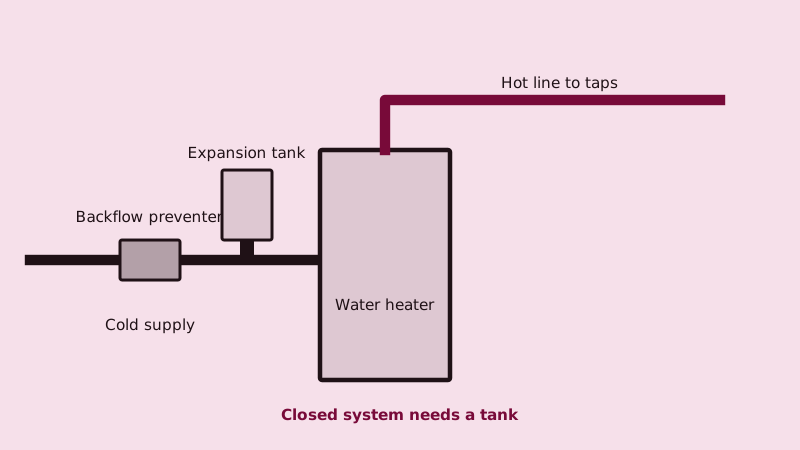
Picture a small steel canister with a rubber bladder and a pocket of air, bolted to the cold-water pipe next to your heater. Warm water needs more space than cold, and inside sealed plumbing the surplus must go somewhere. The canister takes it. When it fails, pressure spikes. Swaps cost roughly $150 to $400 installed; the larger water heater repair picture is a click away.
Why does a heater need this tank at all?
It soaks up the extra volume hot water creates. The contents of a 50-gallon heater grow by roughly half a gallon as they warm, and when the plumbing is sealed, that half gallon drives pressure up inside the pipes and the heater. The bladder compresses and gives the water somewhere to go.
Lose that cushion and pressure can climb until the relief valve opens, which is why a dripping valve is so often the first symptom. Repeated spikes stress fittings, supply lines and the heater itself. Failure normally means the air has leaked out or the bladder has torn.
Is an expansion tank something my house needs?
Often, though it hinges on whether your plumbing is closed. A backflow preventer or pressure-reducing valve at the main seals the loop, so expanding water cannot retreat toward the street. Bob Vila says many modern building codes call for one when an old heater is replaced.
We write "often needed" and not "required" because local rules and your own piping layout both matter. The Whittier Building & Safety Division, (562) 567-9320, can say what it expects for a replacement permit. Homes built or re-piped after about 2002 are more likely to have a closed system, according to one cost guide, and older ones may have an open path.
How can I spot a dead tank?
Typical signs: a relief valve that drips whenever the heater fires, banging when it heats, fixtures that surge, and a tank that feels heavy with water. Press the small air valve on the tank, standing to the side. Water spitting out means a dead bladder; hearing only air means the tank could be fine.
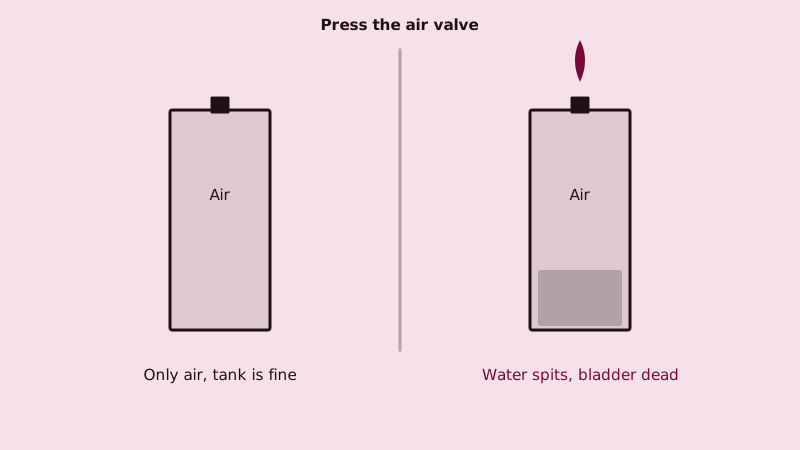
A plumber checks the air pre-charge with a gauge and compares it with your supply pressure. Shut the water off before you test, and keep your face away from the valve. TaskLoco's guide says tanks typically last five to ten years, and budget units can fail in three to five.
What does a replacement cost?
TaskLoco reports $150 to $400 installed, with most markets at $150 to $350. The tank itself costs $30 to $80, and labor runs $100 to $200 for a job of 30 to 60 minutes. Corroded fittings, odd pipe sizes or relocating the tank can add $50 to $150. Bob Vila's guide lists tank prices at $40 to $350.
Added to a heater swap, the tank is one small extra line. Alone, it is a short visit. If your heater is dripping, mention it in a price request and ask for the tank, labor and fittings listed separately. These are published guides; your quote is the real figure.
What size should the new tank be?
A two-gallon tank suits most standard 40 to 50 gallon heaters when household pressure sits in the 40 to 80 psi range, per TaskLoco. Larger heaters, pressure above 70 psi, or a recirculation loop may call for a 4.4 gallon tank, which costs $15 to $25 more.
The California Plumbing Code caps supply pressure at 80 psi, so a house above that needs a regulator before the tank question even matters. A pressure gauge on an exterior spigot reads it. Match the tank's plate rating and pre-charge to that reading instead of guessing.
Should a homeowner try this alone?
Some homeowners manage it, but the steps are many: closing the water, draining the line, relieving pressure, sealing the threads and setting the pre-charge to match supply pressure. If any of that is unfamiliar, hire it out. Gas, electrical and relief valve work near a heater should never be improvised.
If you do proceed, kill the heater's power or gas, plus the water, and use a gauge for the pre-charge, because a wrong setting waterlogs the tank within weeks. Tank swaps often happen during a heater change, and that work normally needs a permit, so a contractor with a state license on file is the safe route.
Can a dead tank hurt the heater?
Indirectly, yes. Repeated spikes strain the tank, the supply connections and the relief valve, and can lead to leaks or early failure. Treat a dripping relief valve as a warning, because one that opens regularly can wear out and leak constantly.
Hard water can leave scale on a valve seat and keep it from closing cleanly, and Whittier's 2025 city report lists hardness near 14.6 grains per gallon. For a dripping valve, read relief valve replacement and the guide to fixing a leaking water heater. Never cap a relief valve's discharge.
Common questions
How long do these tanks last?
TaskLoco gives five to ten years as typical, ten to fifteen in steady-pressure systems, and three to five for budget units. Pressure above 80 psi and big temperature swings shorten that. When a heater is being swapped and the tank is over five years old, have the plumber test it.
Why is the relief valve dripping when the burner kicks on?
A drip at the start of a heating cycle often means thermal expansion with nowhere to go, so the tank has failed or is missing. High supply pressure or a worn valve can do it too. Measuring pressure and testing the tank settles which part to replace.
Should I add one to a house that never had one?
If your system is closed and the relief valve drips, a tank is worth considering, and many codes expect one when a heater is replaced. Ask the plumber to check your supply pressure first. Adding a tank to an open system does no harm but may not be needed.
How much time does a tank swap take?
TaskLoco puts a lone tank swap at 30 to 60 minutes, with the water shut off for part of the visit. Replaced fittings or a pressure check add a little time. Done during a heater replacement, the tank adds almost nothing. For other jobs we arrange, see the home page or the notes on permits for heater work.