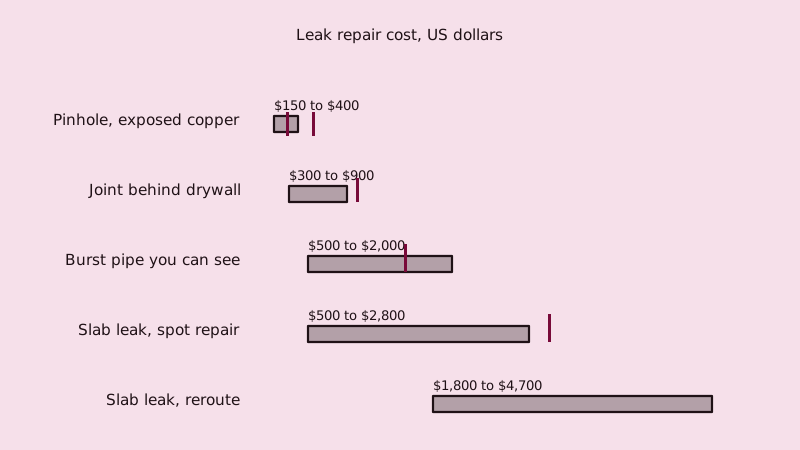
Across two guides we read, slab leaks cost from $500 up to $4,000, and one of them puts the average near $2,000. Where a Whittier job lands depends mostly on access: how deep the failed pipe sits and whether anyone has to break floor to touch it. For how the work goes, start with leaks and burst pipes. Here we stick to dollars.
What does an ordinary leak repair run, before slab work enters the picture?
One guide lists a single accessible leak at about $500 and stretches the full spread from $150 up to $4,700. Pinholes in exposed copper sit at the bottom, while hidden leaks cost more since somebody has to find, open and close the surface. All of it is national data, a map of the territory and never a bid.
| Leak type | Low | Typical | High |
|---|---|---|---|
| Pinhole, exposed copper | $150 | $275 | $400 |
| Joint or coupling behind drywall | $300 | $550 | $900 |
| Burst pipe you can see | $500 | $1,000 | $2,000 |
| Slab leak, spot repair | $500 | $1,500 | $2,800 |
| Slab leak, reroute | $1,800 | $3,000 | $4,700 |
Notice the logic. Anything in plain sight stays inexpensive. Pipe buried in a wall cavity or under concrete adds hours of searching, opening and patching, and those hours are the real cost driver.
Which repair method fits a leak under the concrete?
Four approaches exist, and the pick drives most of the invoice. Plumbing Price Guide lists a spot repair at $500 up to $2,000, rerouting above the floor line for $1,500 to $4,000, epoxy lining from $1,000 to $3,000 and a full repipe running $3,000 to $8,000. Three of the four are one-to-two-day jobs. The repipe stretches over three to five.
Spot repair. The plumber cuts into the floor above the leak, patches that one stretch and closes the concrete. Good fit for a lone failure in a system that's otherwise healthy. Old copper that pinholed once tends to have siblings about to follow, and this method only deals with the section that already quit.
Reroute. The bad run under the floor is retired, and replacement pipe travels through walls or the attic instead. Floors survive. Think of it as the usual answer once a line has quit more than once.
Epoxy lining. A resin coating cures along the bore of the existing pipe. Some layouts can't take it, so an inspection has to come before any promise.
Full repipe. Every supply line gets replaced. Leaning toward it? Patch versus replace is argued out in comparing a slab patch with a repipe.
What does it cost just to find the leak?
Pinpointing the leak costs $150 up to $400 in one guide and $250 up to $750 in another. The gap mostly reflects equipment and who is doing it. Typical methods are acoustic listening, pressure testing and thermal imaging. Ask whether that charge is credited back should you hire the same company for the fix.
You can do some detective work yourself. Close every fixture and appliance, then go look at the meter. EPA's method is to jot down the dial, leave all taps shut for 120 minutes, then read it again; a moved needle tells you water is going missing. Other tells: a floor patch that stays warm, hissing in a silent kitchen, or a bill that jumped for no reason. Locating charges are broken out under leak detection cost.
Can I build my own estimate, calculator style?
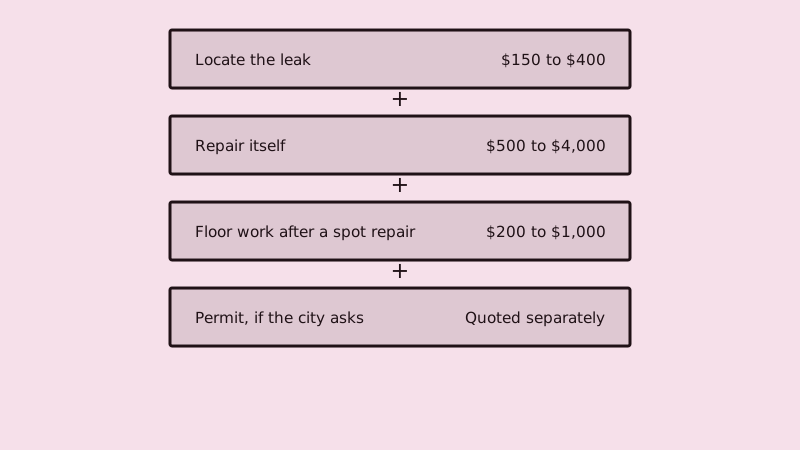
Yes, using four lines: locating the leak ($150 up to $400), the repair itself ($500 up to $4,000 by method), floor work afterward ($200 up to $1,000 following a spot repair) and any permit the city asks for. Ask each contractor to price every line separately, and the quotes become comparable.
Three things tend to push the total up:
- More than one leak, which nudges the job from patching toward rerouting or repiping.
- Awkward location, such as under a kitchen island, a built-in cabinet or tile you want matched exactly.
- Tired pipe. Material that has already leaked once is a weak sign for the rest of it.
Pressure deserves a mention. California's rule on supply pressure, 608.2, names 80 psi as the cap. A house running above it is hard on every fitting, and replacing a failed regulator is priced between $150 and $350 in the guide.
Which clamp holds a pipe that is leaking, at least for a while?
A pipe repair clamp pairs a rubber pad with a metal band, and it tightens over a small hole or split along a straight section. A pinhole is its sweet spot. A weeping joint is not. In a house it buys time until the real fix, and under a slab it does nothing.
Trying to hold a dripping connection until help arrives? Close the water supply before anything else. Then reach for a clamp sized to the pipe, self-fusing silicone tape or putty labeled for drinking water. Fittings get a step-by-step treatment in repairing a pipe joint that weeps, and leaks in plastic pipe handles PVC and PEX.
Do not try to reach a slab leak with a masonry saw. Concrete and live water lines are a poor mix for a weekend project.
And a burst pipe, or a leak hiding in a wall?
In the guide, a burst you can see costs $500 up to $2,000, with $1,000 as the typical figure, and a joint leaking behind drywall costs $300 up to $900. Someone opens the wall and swaps the damaged section. Patching and painting belong to a different trade, so find out who covers that and for how much.
Often the pipe is the smaller expense and the soaked drywall is the larger one. Close the main shutoff, let the pipes drain through a bathtub or hose bib, and carry valuables clear of the wet spot. The repair is described under burst water pipe, and cleanup is covered in drying and damage after a burst.
Hot-water radiator lines are repaired the same way, though hydronic heat is not common around Whittier. Shut off its supply and let the plumber look. A leak near an access hatch or crawlspace door costs whatever the pipe costs: if the plumber can see it, it is a cheap job.
Typical plumber prices in Whittier
One guide lists West Coast rates as $95 up to $175 hourly, $100 up to $175 per service call and $175 up to $350 hourly for emergencies, often with a one-hour minimum. The CSLB threshold sits at $1,000 counting both labor and parts, and permit jobs fall under the same rule. Nearly every slab job qualifies.
Verify the contractor's standing with the CSLB before signing. Written contracts begin at $500. Inside city limits, permits and inspections come from Whittier's Building and Safety office; nearby cities each keep a separate office.
Send a price request below and we'll arrange for someone local to quote it. Expect detection, method, restoration and permit itemized apart.
Comparing providers before you book? The guide to slab leak repair companies lists what to ask each one.
Common questions
When will my floor be back to normal?
Spot repairs, reroutes and epoxy lining each fit in one to two days, based on the guide, while a repipe needs three to five. The leak is normally located during the first visit. Floor patching, matching tile or drywall finishing can push the schedule well past the plumbing itself.
What do I need to learn before accepting a bid?
Find out if locating the leak is credited toward the fix, which method is proposed and the reasoning, whether flooring and permit costs are inside the total, and how many leaks showed up. Confirm standing with the CSLB. Then ask how a second leak later would be handled.
Can I go out while the work happens?
Yes, after an adult has unlocked the door, shown where the meter and shutoff are, and agreed to any change in plan. Pets and small children should stay away from opened floor. Expect dust, and clear rugs or breakables from the area beforehand.
When is a slab leak a true emergency?
When water keeps spreading, the main refuses to close, or the electrical panel sits near the wet area. Stay clear of the panel and call at once. If the main shuts and floors stay dry, you have room to collect a few quotes. Water meeting electricity is the real hazard.
Can I ignore a small one?
That is a poor bet. EPA reckons leaks cost the average home over 9,300 gallons per year, and a hidden one under concrete may be softening soil and lifting flooring unseen. Once you suspect one, have it located and priced rather than assuming it will stay small.
For what the work involves beyond the price, see plumber in Whittier.