Plunge it properly three times, and if the bowl still sits full or drains at a crawl, the stoppage has moved past what rubber and elbow grease reach. a motorized snake, or a scope pushed down the line, does that job. someone local drives to your Whittier address, and the cost is stated in writing ahead of any work.
When does a stopped toilet stop being a do-it-yourself problem?
Once the plunger has failed three honest attempts, or the clog comes with a second symptom, stop. Gurgling in a shower, water sitting in a tub after you flush, or a bowl that rises and holds all point to trouble in the branch line. That is a machine job, not a plunger job.
A few situations skip the plunger stage entirely:
- Something solid went in: a toy, a razor cap, a brush head. Plunging can jam it sideways.
- Wipes labeled "flushable." They do not break up like paper.
- The same toilet stops up every week or two. Something downstream is snagging each load.
- Sewage-smelling water appears in whichever drain sits lowest in the house.
Plenty of homes around central Whittier and out toward Hacienda Heights date to the postwar building boom, when drain lines were cast iron or clay. Those pipes roughen, shift and admit roots as they age. A toilet is often the first fixture to complain.
What is worth trying before I phone anyone about a stopped-up toilet?
Grab a flange plunger to begin. That is the kind with a second rubber sleeve that seats in the outlet. When that gives up, borrow or buy a closet auger. Both are cheap hardware-store items and neither harms the porcelain. Skip drain chemicals, and skip boiling water.
Order of attack:
- Close the toilet's supply valve on the wall (clockwise) or lift the tank float so the bowl cannot refill and spill.
- Seat the flange plunger so it holds water, then push gently first, to let the trapped air out, then work it up and down evenly.
- Still stuck? Feed in the auger until it stops, turn the crank, and withdraw slowly.
- Pour in a bucket of warm tap water from knee height. If it swallows the water, the clog is gone.
Does dish soap do anything? It slicks a paper jam so it slides along, and that is all. Baking soda plus vinegar makes a show and rarely moves anything. Boiling water risks a cracked bowl, a repair far costlier than the clog.
What happens when a clogged toilet is left alone?
Usually it stays put, right up until someone flushes. Then a bowl that looked calm spills over the rim, spreads onto the flooring, and soaks the baseboards. A blockage rarely clears itself, and paper gathers on whatever is already stuck.
Water that went over the rim is the real expense. Floor material soaks it up, and cleaning up after dirty water costs much more than the visit that would have prevented it. If the floor around the base is soft or the room smells damp afterward, mention it on the request.
Separate fault, sneakier: the tank that never quits running after a flush. A worn flapper can leak many gallons without any noise. The EPA estimates the leaks in an average household come to upward of 9,300 gallons annually. Our pages on flush problems and the endlessly running tank cover that side.
Is it normal for the toilet and shower to drain into the same pipe?
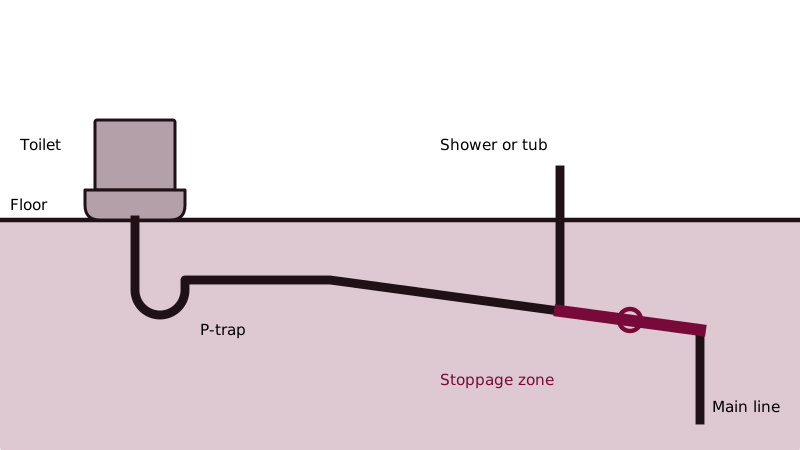
They do, in most houses. Toilet, sink and tub typically feed one branch that heads for the main line under the slab or yard. So if the toilet backs up and the shower gurgles in response, the stoppage sits beyond the spot where those two lines meet.
That pattern matters on a job. When only the toilet misbehaves, the plumber works near its trap. When several fixtures act up together, the work moves farther down the line, and a camera tells you whether you have a single clog or a bellied, root-filled pipe. Sinks have their own story in the slow-draining sink guide.
Do plumbers handle the drain pipe itself, and with what?
Yes. A drain machine, in plain terms a spinning steel cable tipped with a blade, opens most blockages. For heavy buildup, hydro jetting blasts the pipe wall with pressurized water. A compact camera, fed on a flexible rod, goes down before or after the cable, so you see the line rather than guess at it.
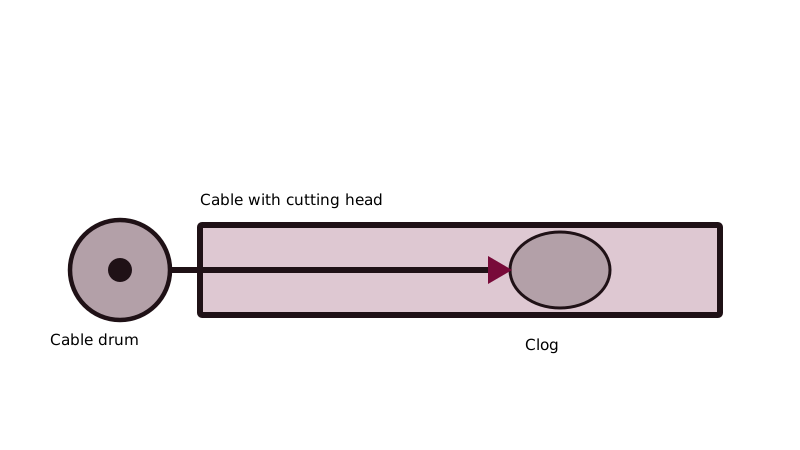
Typical sequence on a stubborn clog:
- Cable the line to restore flow.
- Run the camera to see what caused it.
- Jet only if the pipe is sound and coated with scale or grease.
- Quote a section repair If the picture reveals a crack, a sag or a collapsed joint.
Cleaning a line that is breaking down buys weeks, not years. Roots and broken clay are the usual stories behind a toilet that clogs on a schedule in tract-home neighborhoods like those in Whittier and Santa Fe Springs.
How much should I budget for clearing a stopped toilet?
No honest flat number exists, because clog depth, how easily the bathroom can be reached and what hour the visit falls on. Published guides list plumber rates of somewhere near $75 to $150 per labor hour, with a separate trip charge somewhere between $50 and $200, rising for emergencies. Use that as a rough frame only. Published ranges only orient you; the number in your own written quote decides.
Raises the bill: a visit outside weekday hours, a clog that needs the toilet pulled and reset on a fresh wax seal, and a camera inspection. What keeps it down: a clear path to the bathroom and a plain description of what happened. For comparisons, open the toilet unclogging price page. We do not state a flat price here, since that would be a guess.
Why does a toilet flush weakly or keep refilling?
Weak flushing, phantom refills and a bowl that never quite empties usually trace back to one of three sources: a flapper gone soft and leaky, a fill valve adjusted badly, and mineral scale. None is a clog, but each gets mistaken for one.
Hardness is a real factor here. City of Whittier water averaged 250 mg/L total hardness in its 2025 report, which USGS places in the "very hard" band above 180 mg/L. Scale can narrow the small jets under the bowl rim over the years. If the flush feels lazy and nothing is stuck, ask the plumber to check those holes.
Is a mobile home toilet different?
Yes, mostly in the plumbing underneath. The drain is a short run of thin plastic pipe, so a wipe or a toy stops it faster, and the part you need to reach may be under the floor. Plunge lightly, avoid chemicals, and call early. A park may own the sewer lateral, so ask management too.
Who do I tell what, when I book?
Use the request form to say which toilet is affected, the fixes you have already attempted and whether another drain is sluggish. A local plumber then makes the visit, gives you the price and carries out the work, with the quote delivered in writing beforehand.
Handy to have nearby:
- The bathroom's location and whether the toilet is upstairs.
- Anything that might have gone down it.
- Whether chemical cleaner was used (it matters for safety).
- Past clogs and when they happened.
If you want the general picture of a visit, the plumber service overview walks through it, or head back to the start page.
Common questions
What if the house has no plunger at all?
Squirt a generous dollop of liquid soap in, then pour in a gallon of hot water, not boiling, held at hip level. Give it a quarter hour. A cloth-wrapped wire hanger can nudge soft clogs along. A solid object will not budge this way, and that means a closet auger or a plumber.
Do drain chemicals belong in a toilet?
No. Toilet water sits still, so caustic liquid lingers where it could splash back at you or at whoever works on the bowl next. It rarely dissolves a solid blockage and can attack old pipe. Plunge or auger instead, and tell the plumber if any product went in.
Why does my toilet clog again right after it clears?
Something farther down the line still catches paper on every flush. Usual suspects include wipes, a flush too gentle to carry waste along, and roots in an aging line. If it repeats within days, ask for a camera look rather than another quick clearing.
Can a clogged toilet raise my water bill?
The clog alone will not. A toilet that keeps running because the flapper failed will. Tint the tank water with food coloring, wait ten minutes without a flush, then look into the bowl. If the dye has crept through, the flapper leaks around the clock.
Is this going to take all afternoon?
A simple blockage may be done inside an hour. A deeper stoppage that needs a machine or camera runs longer, and a stuck object that requires lifting the toilet adds time to set it back. The plumber can estimate the length when giving you the quote.
In this section
- Drains
Hot water, baking soda, a plunger and a hand snake can clear many sink clogs.
- Drain cleaning and clogs
Fix a slow bathroom sink in order of effort: clear the stopper, clean the trap, snake the line.
- Slow kitchen sink
Fix a kitchen sink that drains slowly: check the strainer and disposal, clear the trap, use a plunger or snake, and learn when the problem…
- Drain cleaning and clogs
Unblock a clogged toilet with a plunger, hot water and dish soap or an auger, avoid damaging cleaners and learn the signs of a deeper…
- Drain cleaning and clogs
Step-by-step ways to unclog a kitchen sink, from hot water and a plunger to the trap and a hand auger, plus signs the blockage is deeper.
- Drains
Pull the pop-up stopper, plunge correctly, clean the P-trap and spot a deeper blockage.
- Drain cleaning and clogs
Garbage disposal humming, jammed or backing up with standing water?
- Costs
Unclogging a toilet usually runs $150 to $350 from a plumber, more if the main line is blocked.
- Softener drain lines
Where a water softener drain line should end, why it needs an air gap, how to avoid clogs and backups, and the sewer questions to ask…
- Drain cleaning and clogs
A sink that drains slowly has a partial blockage, a vent problem or buildup in the pipe.