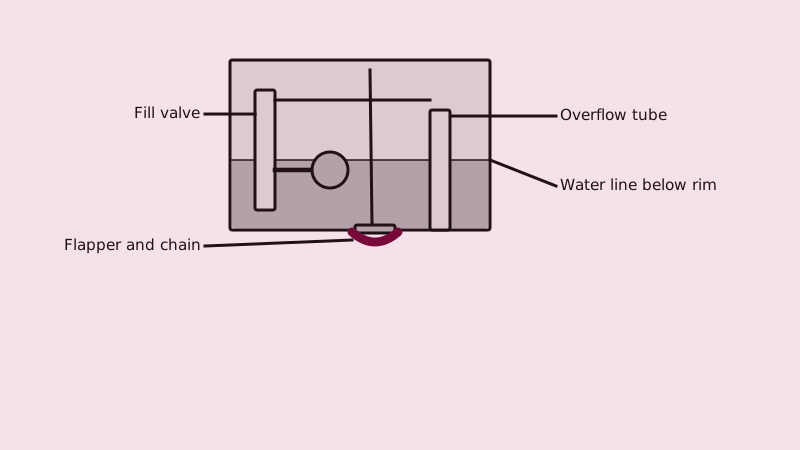
Lift the porcelain lid and stare into the tank for a minute. Usually one of three cheap parts has quit: the rubber flapper, the refill valve, or the float that tells it when to stop. Each swap is a short job. If you would sooner hand it off, our toilet repair service sends a local plumber, and Bob Vila prices a professional fix around $60 to $150.
Why won't the tank stop refilling?
Either water slips past the tank seal into the bowl, or the tank never learns it is full. A flapper gone stiff or warped lets a thin stream creep past its seat. A fill valve that sticks open keeps pouring. A float riding too high sends the extra water down the overflow tube and out of sight.
Listen first. A thin hiss with the tank low blames the fill valve. A faint trickle in the bowl, then a refill every few minutes, blames the flapper. Water running into the tall center pipe means the float rides too high. Looking costs nothing and saves buying the wrong kit.
Flapper trouble or fill valve trouble?
Try the dye test that EPA WaterSense recommends. Stir in a little food coloring, then stay away from the handle for a ten-minute wait before you look at the bowl water. Tinted water there says the flapper or its seat leaks. A clear bowl plus a tank that still tops itself up points upstream, at the fill valve or float.
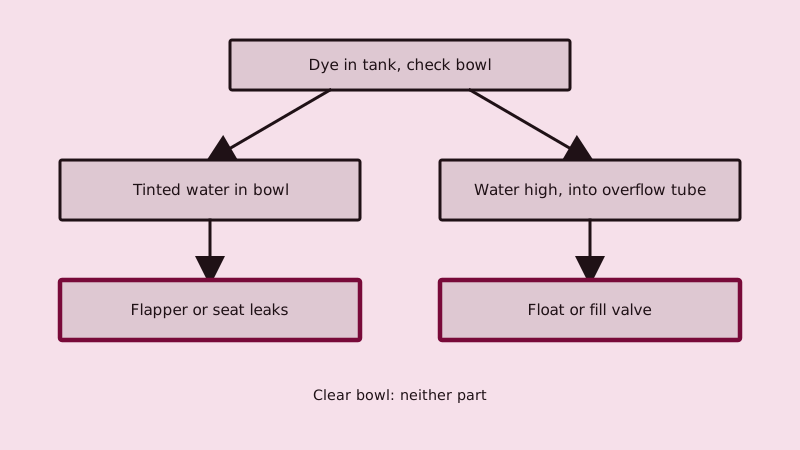
Then check the water line against the overflow tube. About an inch of gap below the rim is right. When water spills into the tube, the float or valve needs attention. Bob Vila gives roughly 20 minutes of working time for a fill valve replacement. The pages on flapper replacement and fill valve repair show each part.
What does a fix come to?
Bob Vila's figure for professional toilet repair is $60 to $150, and $10 to $30 for the fill valve parts if you do it yourself. Add cost when a shutoff valve seizes, tank bolts are rusted solid, or the toilet is so old that replacing it is smarter.
| Path | Typical figure |
|---|---|
| Fill valve kit, DIY | $10 to $30 |
| Visit and repair by a plumber | $60 to $150 |
| New toilet | see toilet replacement cost |
Consider these ballpark; your quote is the number that matters. If other bathroom drips need attention, list them in the price request so one visit can cover everything.
Why does my toilet run only once in a while?
A flapper with a tiny leak behaves like a ghost. Water seeps out, the level slips a hair, the fill valve opens for a few seconds, and silence returns. You hear it perhaps once an hour. That pattern is the classic sign of a flapper wearing out slowly.
Do not ignore it. On EPA's numbers, the typical household wastes 9,300-plus gallons yearly through leaks, and one old flapper may account for thousands of gallons by itself. The agency also wants flappers swapped about every five years.
What stops a toilet that runs nonstop?
Start at the oval valve down by the baseboard and turn it off. That halts the flow while you work. Then inspect the flapper chain: it needs a hair of slack, and no loop may wedge beneath the flapper. Make sure nothing, such as a bent handle arm, holds the flush lever partly down.
Press the flapper into its seat with a finger. If the water quiets, the flapper has worn or warped. If the noise carries on, turn to the float and the valve. Lowering the float cup or turning the adjustment screw a quarter turn often does it. A cracked or loose tube is described under overflow tube repair.
What if the toilet itself wobbles on the floor?
A toilet that rocks needs its base bolts snugged or its wax seal redone. Nip each nut a little, switching sides, until the movement stops. Porcelain cracks easily, so stop when resistance rises. If the rocking persists or damp patches appear around the foot, the seal has failed and the toilet must come up.
Lifting a toilet is a two-person job, and a spongy or musty floor under it deserves a plumber's attention before anything else. Loose seats are a different matter and an easier one; see the page on toilet seat repair.
What prep comes before the screwdriver?
Close the wall valve, press the handle until the tank drains, and snap photos of the parts so reassembly is no puzzle. Carry the old flapper or valve to the store, because universal parts do not seal every brand. A mismatch costs you a second trip.
Handle with care. Tank lids are heavy porcelain, and old bolts snap. Whittier's municipal water averaged 250 mg/L of hardness in the 2025 report, and mineral crust is a frequent reason a flapper stops sealing and bolts seize. This is a plumbing task, unrelated to heating or air conditioning, but the principle is the same for any home system: if a step needs force, pause.
When is booking a visit smarter?
Book a visit if the wall valve will not turn, the porcelain has a crack, water seeps from the base, the first repair did not last, or the toilet is a pressure-assist or wall-hung design. Their parts are specialized and a store-bought kit rarely fits.
Below $1,000 the state does not demand a contractor license, and a simple toilet fix lands well below that, though a new supply line or valve behind the wall can add up. Every visit begins with a written quote. The service areas page shows which neighborhoods we cover, and the home page introduces the rest of what we do.
Common questions
How long until the toilet is quiet again?
Swapping a flapper takes ten minutes. Bob Vila allows roughly 20 minutes of work and 40 minutes overall for a fill valve, counting the water shutoff and test flush. A visitor with parts on board is often done in under an hour, longer if a valve or supply line behind the toilet also fails.
What should I ask before saying yes to a repair quote?
Insist on a written total that spells out parts, labor and a possible trip charge. Find out if both the flapper and fill valve will be replaced when both look worn, and who pays if the fix fails. If the job swells toward $1,000, write down the license number and run it through the state board's lookup.
Who needs to be at the door?
An adult should greet the visitor, show the toilet and wall valve, and approve the finished work at the end. Please keep pets away from the bathroom. If you cannot be there yourself, say in your request who will unlock the door and when that person will arrive.