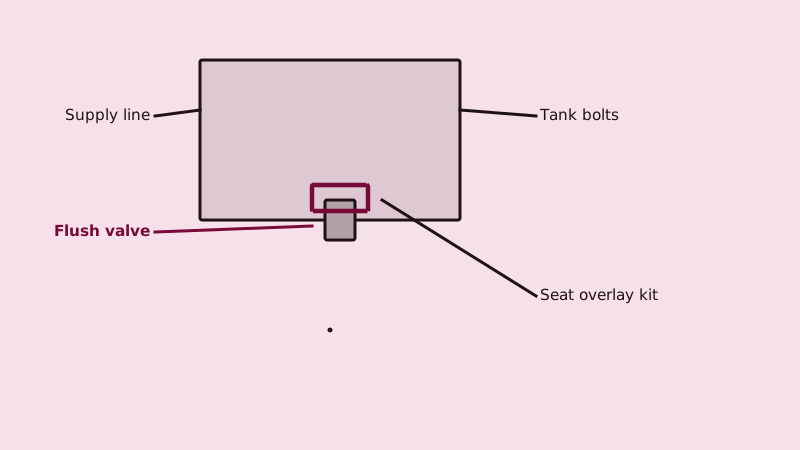
The short answer: not a true replacement. On a typical two-piece toilet, the nut that secures the flush valve sits underneath the tank, which means detaching the tank from the bowl. If the tank is to stay on, the realistic option is repairing a worn seat using an overlay kit. If you cannot tell which applies, a plumber can sort it out fast. Other tank problems are discussed in toilet repair.
Is a flush valve swap possible with the tank still on?
Not a full one on a two-piece toilet, because the locknut holding the valve is under the tank. A repair kit can instead be set over a worn seat, with a new flapper, all while the tank stays put on the bowl.
One-piece toilets share the limit. Tank and bowl are one casting, so the tank cannot be lifted, and a seat overlay is the usual repair when the valve is serviceable. Some low-quality guides claim the whole valve can be exchanged from inside the tank. The more detailed manufacturer and plumbing sources do not back that up.
Pin down the real problem first. A worn flapper alone needs only a flapper, as covered in flapper repair. A rough seat may suit a kit. A cracked tube or valve body needs the full replacement.
What does a no-removal kit actually do?
It adds a new seat ring that adheres over the old, damaged seat, plus a flapper that fits it. Per the product listing, it is a peel-and-stick design that goes in without lifting the tank. The old seat must be intact and clean, and the valve has to be the size the kit was built for.
The common fit is a 2-inch flush valve opening. Many newer toilets use 3-inch valves, so measure before buying: a 2-inch kit won't seal a 3-inch opening. Check the model name or flapper size, or measure the opening in the base of the tank.
Published guides describe the steps like this:
- Close the shutoff behind the toilet.
- Flush, keep the handle down till the tank drains, and sponge up the last bit.
- Unhook the chain and pull the old flapper.
- Scrub the old seat clean and dry so the adhesive grips.
- Press the new seat ring over the old seat, working around the rim.
- Fit the new flapper, leave the chain a little slack, open the shutoff again and let the tank fill.
Respect the adhesive's cure time before a test flush. Then drop dye in the tank and check the bowl after ten minutes of no flushing.
When will a seat overlay fail?
When the old seat is cracked or deeply pitted, when the valve body is damaged, when the valve is an unusual size, or when the tube is cracked. Mineral scale that will not scrub off also prevents the adhesive from holding.
Warning signs: water still seeping into the bowl after a fresh flapper, a seat that wobbles, a cracked tube, or dampness coming from beneath the tank at the valve base. Those leaks come from the tank bolts or the spud washer, not the flapper seat, and fixing them means lifting the tank.
Whittier's city water tested at 250 mg/L total hardness on average, according to its 2025 report. Scale roughens seats faster than in soft-water areas, so seat wear and repeat flapper changes are more common than average.
What does a full flush valve replacement involve?
Shut the water, empty the tank, undo the supply line, then back out the bolts that hold the tank down and lift it free. Remove the big locknut beneath the valve, pull the old valve, and drop in the new one with its gasket. Seat the tank on a fresh spud washer and snug the bolts evenly.
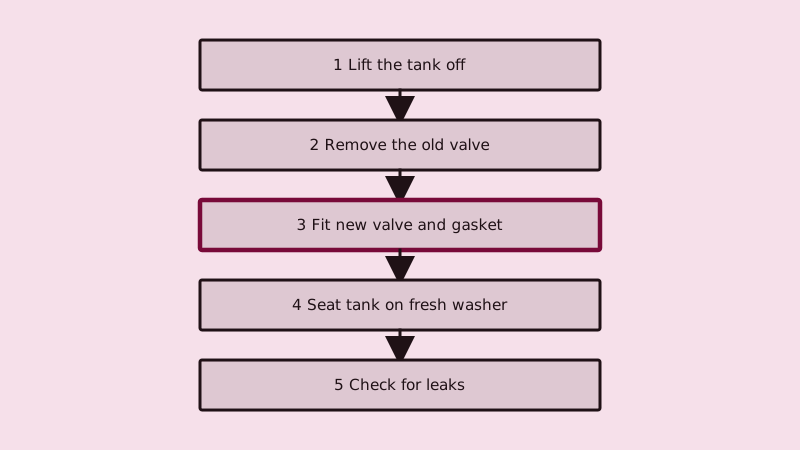
Overtightening cracks porcelain, which is why many people hire it out. A tank is heavy, and lifting it badly can chip the bowl. Rest it on a towel. If the bowl rocks or the wax ring is aging, reset it during the same visit.
Rusted bolts on older toilets sometimes have to be cut off by a plumber. That comes up often in 1950s tract homes around Downey and Norwalk. Census figures put the median Downey home at about 1959 and the median Norwalk home near 1957.
What would a plumber's bill look like?
A 2026 cost survey lists plumbers at $75 to $175 per hour with a call-out charge of $75 to $200, and toilet replacement at about $200 to $500. A flush valve job with the tank off usually fills an hour or two. A seat kit is a short job a homeowner can handle.
If the toilet is old, stained or rocking, compare the repair with a new unit. A current model has a more dependable flush valve and is often better value than a second repair. See toilet replacement pricing.
Running toilets waste water. The EPA notes that a flapper in bad shape can quietly squander thousands of gallons, and it estimates typical home leakage past 9,300 gallons yearly. That is the argument for fixing it promptly.
For a written price, request a quote. The Rio Hondo Plumbing main page explains how visits come together across southeast LA County.
Common questions
Can the flush valve be changed while the tank stays mounted?
Not fully, on a two-piece toilet, since the main nut hides under the tank. A no-removal kit can rebuild a worn seat in place, but a cracked valve body means unbolting the tank, so check the valve body before deciding.
What do repair kits cost?
Prices differ by brand and size, and no sourced figure is available for us to quote. Check the kit's listing, confirm the 2-inch size, and weigh it against a plumber's visit, for which a 2026 survey lists a call-out charge of $75 to $200.
How can you tell a 2-inch valve from a 3-inch one?
Measure the hole at the tank's base, or across the flapper. Two-inch valves are the older standard, and many newer toilets use 3-inch valves. A kit made for one size will not seal the other, so measure before buying and keep the receipt.
Is a flapper leak the same as a flush valve leak?
No. The flapper is the rubber disc that lifts with each flush. The flush valve is the full assembly, seat and overflow tube included. A fresh flapper cures most leaks. If one doesn't, the seat or valve itself is worn.