Whatever is dripping, the cure is a worn part inside the faucet: a rubber washer in older twin-handle models, a replaceable cartridge in most single-lever ones, or springs and seats in ball-style faucets. Name your faucet's type, turn the water off, change the part, and test. The wider range of work is described by the faucet, sink and disposal plumber page.
Which of the four faucet types is on your sink?
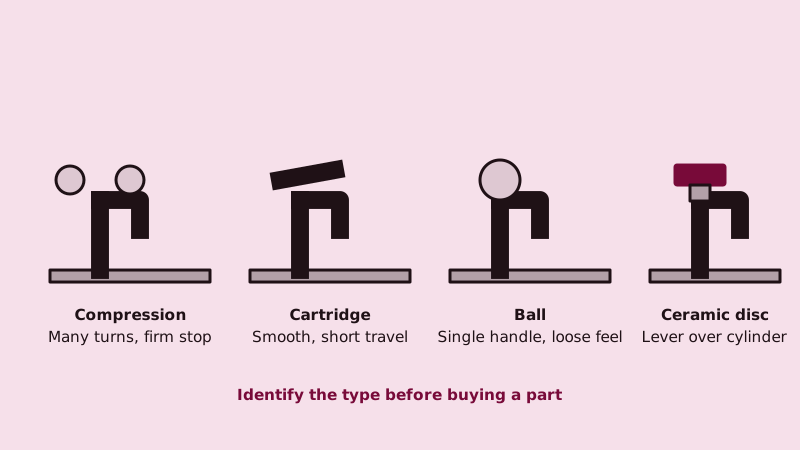
Compression faucets pair two handles that wind through many turns before stopping hard. Cartridge faucets glide through a short arc. Ball faucets use one lever on a rounded cap, while ceramic disc faucets use one lever over a cylinder. The type picks the part, so identify yours before shopping.
| Type | Feel | Usual leak point | Part to replace |
|---|---|---|---|
| Compression | Many turns, firm stop | Spout drip | Rubber washer and seat |
| Cartridge | Smooth, short travel | Spout or base | Cartridge or O-rings |
| Ball | Single handle, loose feel | Base or spout | Seats, springs, O-rings |
| Ceramic disc | Smooth, cylinder inside | Spout or base | Disc cylinder |
Look for a maker's name on the handle or spout, or a model stamp on the underside. Shop with the old part in your pocket and the match is easy.
What does the location of the drip tell you?
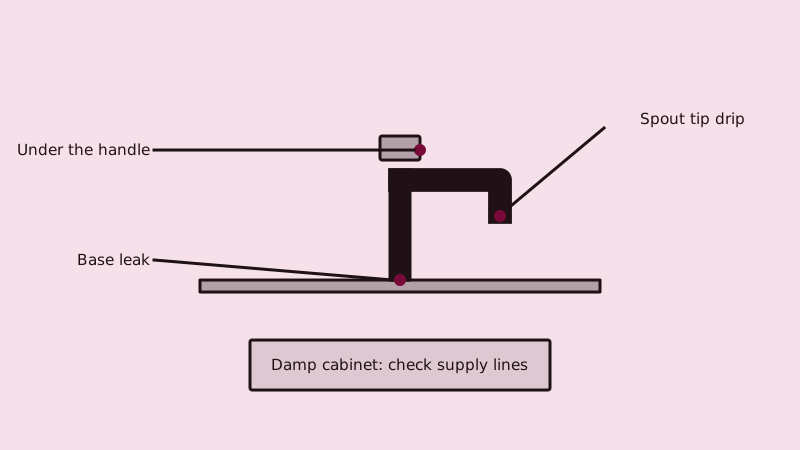
The spot where water appears points to the failed part. Beading at the spout with everything closed means a worn washer, a tired seat or a failing cartridge. Wetness around the spout's base means an O-ring. Water under the handle means a slack packing nut or tired stem seals. A soaked cabinet suggests supply lines.
Towel the faucet dry and watch it. Then get beneath the sink with a flashlight and press dry paper towel to every connection. Water that appears only when the faucet runs is the faucet's fault. Water that is always there belongs to a supply line, shutoff valve or drain; see leaks under the sink.
How do you change a worn washer or cartridge?
Turn off both stops below the sink, open the faucet until the line goes quiet, and put a stopper in the drain so no screw is lost. Lift off the handle cap, remove its screw, lift the handle clear and spin off the retaining nut. Extract the old washer or cartridge and seat the matching one.
On a compression faucet, in order:
- Close both angle stops below the sink.
- Lever up the decorative cap, then unscrew the handle.
- Loosen the packing nut with an adjustable wrench, wrapping the nut in a rag so the finish is not scarred.
- Pull the stem free. A rubber washer rides on its tip, secured with a small brass screw.
- Replace the washer and the stem's O-ring, and look for pitting on the brass seat.
- Reassemble, open the stops and test.
A cartridge slides straight out once its clip or nut is off. Match the replacement by size and brand, and line up the tabs before pushing it home.
Why does it drip after the repair?
The usual reasons are a pitted seat, a replacement in the wrong size, or scale propping the seal open. Hardness in Whittier's city water averaged 250 mg/L in its 2025 report, near 14.6 grains in a gallon. Soak and scrub scale from the seat and aerator, or replace the seat.
A seat-dressing tool smooths a compression faucet's brass seat. On a cartridge faucet, the cartridge bore or the faucet body may be worn. A faucet that drips after two repairs has run its course.
Scale also clogs the aerator, which sends the stream sideways. Unscrew it, let it sit in vinegar, and brush it clean.
Repair it or put in a new faucet?
Keep a sound faucet when the fix is a cheap part. Replace it once the finish is worn, the body is pitted, parts have been discontinued, or the repair approaches the cost of a new one. One 2026 survey lists a plumber fixing a leaky faucet at about $150 to $300 and replacing one at about $200 to $400.
Those are guides rather than quotes, but they show the logic. If fixing costs $150 to $300 and a new faucet installed costs $200 to $400, retiring a tired faucet is often the better value. Faucet installation pricing breaks the numbers out by type.
What does a drip cost you?
The EPA's figure for one drip a second comes to more than 3,000 gallons across a year. A washer-priced repair pays for itself fast, while a long-running drip erodes the seat until the job grows. Faucet leaks and the water bill shows the math and the meter test.
Tub and shower faucets work differently; for them, see leaky faucet repair in general.
When should you hire a plumber instead?
Whenever the stops refuse to close, the faucet is old and corroded, the source is a supply line or the sink drain, or a repair failed to hold. Also when the cabinet has been soaked, since a damp base can hide a bigger problem.
A plumber can replace stuck angle stops on the same visit, so you do the work only once. To get a price in writing, send a request. The Rio Hondo Plumbing main page lists the Whittier-area cities served.
Common questions
What fixes a leak under the handle?
If water seeps around the handle, give the packing nut a slight turn, or replace the stem's O-ring or cartridge. Shut the supply first, take the handle off and swap in a fresh seal. A handle that leaks again after that may have a worn stem or body.
How do I repair a one-lever faucet that leaks?
Most one-lever models hide a cartridge or ceramic disc. Stop the water at the stops, remove the lever and cap, pull the cartridge and fit an exact match with new O-rings. A ball-type faucet needs fresh seats and springs instead, usually sold as a kit.
Is it okay to work with the supply still on?
No. Close the stops beneath the sink first, then run the faucet to drop the pressure. If the stops are stuck, close the house main and call a plumber, since forcing a seized stop can snap its stem and flood the cabinet.
How much time does it take?
A washer or cartridge swap often runs under an hour with the correct part on hand. A corroded seat, stuck handle or seized stops stretch it out considerably. Hunting down the matching part is usually the slowest step, so photograph the old one first.