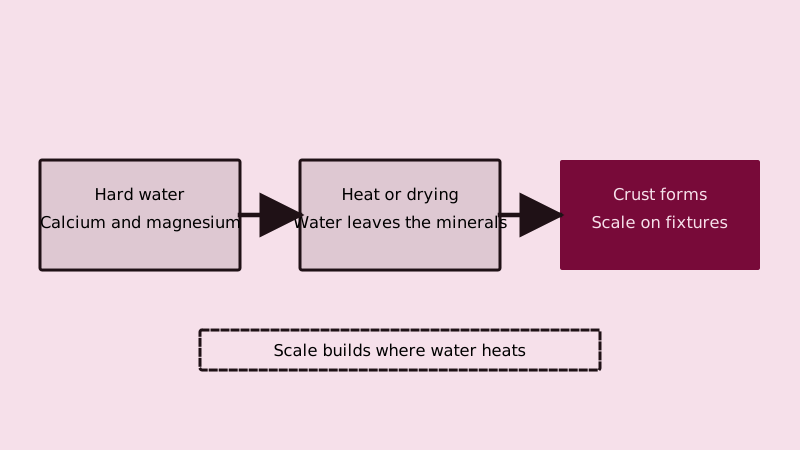
Heat and evaporation turn dissolved hardness into crust. So you can strip out the minerals, alter how they behave or reduce the heat. Your first move is learning your number, which the city puts near 250 mg/L. The permanent fix is explained under softener installation, and every other service starts from the home page.
What number should you expect from Whittier water?
In its 2025 report the city gives an average of 250 mg/L, across samples ranging 230 to 270. For this purpose mg/L and ppm are the same, and dividing by 17.1 gives grains per gallon, roughly 14.6 here. USGS labels anything past 180 mg/L "very hard"; Whittier lands solidly there.
USGS bands, in mg/L: 0 to 60 soft, 61 to 120 moderate, 121 to 180 hard. Not every address receives city water, so the document that matters comes from whichever utility bills you. Do not confuse hardness with pH, which describes acidity. The rating chart on a test strip box is only an approximation.
Where does scale come from?
Calcium bicarbonate in solution converts to solid calcium carbonate once the water warms or dries out, and that chalky crust is scale. It piles up wherever heat or evaporation occurs: heater elements and tank floor, kettles, dishwashers, showerheads, faucet tips and shower glass.
Three conditions matter most:
- Mineral level. More dissolved calcium means faster scale.
- Temperature. Hotter water drops minerals sooner, so a high heater setting speeds buildup.
- Time and flow. Slow trickles and standing water leave deposits as droplets dry.
Look inside any older faucet aerator in the area and you can usually see it. Inside pipes the same crust narrows the passage over years, and that is one reason pressure fades at old fixtures.
Which prevention methods work, and how well?
A salt-based or potassium softener removes the minerals and is the only method on this list that clearly prevents scale throughout the house. Lowering the water heater temperature, flushing the tank and wiping fixtures dry reduce the damage. "Anti-scale" conditioners change how crystals form, but results vary and I would ask for independent test data before paying.
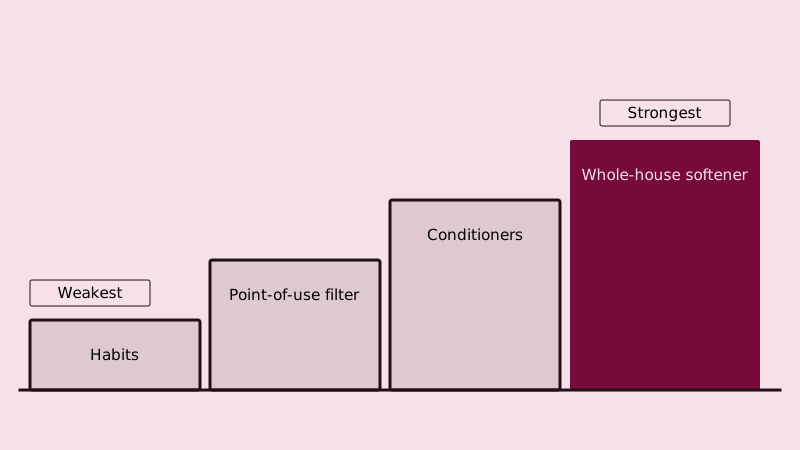
From strongest to weakest:
- Whole-house softener. Inside the tank, resin beads grab calcium and magnesium and release sodium or potassium. See what installation costs and how a salt-based unit goes in.
- Template-assisted crystallization or other conditioners. They do not remove hardness. They aim to make crystals that rinse away. Marketing claims are bold, and independent evidence is mixed, so ask about test results.
- Point-of-use filters. A cartridge on one tap helps that tap only.
- Habits. Wipe glass, descale a showerhead with vinegar, and use rinse aid in the dishwasher.
What can you do at the water heater?
Turn the thermostat down to what you actually need (120 degrees Fahrenheit is a frequent choice), draw off a few gallons through the bottom valve every year to carry sediment out, and get the anode rod inspected. Hot water scales faster, and a tank buried in crust runs longer, wastes fuel and corrodes sooner.
Wait for the tank to cool before draining, since the water scalds. A tank flushed for the first time in years can plug its drain valve; if only a dribble emerges, stop and hand it to a plumber rather than forcing the valve. A rumbling or popping sound while heating usually means mineral layers on the bottom. Our anode rod guide and the water heater service page cover the rest.
Is it worth installing a softener in Whittier?
For most homes on very hard water, probably yes, if scale is already showing. The upside is cleaner fixtures, less crust in the heater and appliances and easier soap rinsing. The costs are the unit, salt or potassium and a drain connection. Ask your supplier and city about local rules on salt-based systems, which I could not verify.
Softening is not filtering. Chlorine and contaminants pass through, so add a filter if taste matters. Some homeowners worry a softener raises the water bill, and the water softener and high water bill page answers that. To plan the job, start with how the softener installation process works, and for a number on your own house, send a quote request.
What shows that the fix is holding?
Watch for fewer white rings on faucets, shower glass that stays clearer between cleanings, and quieter heating. A hardness strip dipped in treated water should read close to zero if the softener works. Check the heater by draining a bucket once a year: less grit means less deposit.
Keep notes: the date of any softener service, the salt level and the first time you saw crust return. Returning scale after a softener usually means exhausted resin, a failed valve or a bypass left open. A plumber can test hardness before and after the unit.
Common questions
Which ppm figure means the water is hard?
By USGS bands, 121 to 180 mg/L (ppm) is hard and anything higher is very hard. Whittier's city water averages about 250 mg/L, so it falls in the very hard class. Many people notice scale above roughly 120 mg/L, but the effect depends on temperature and how much hot water you use.
Does a softener stop scale on the water heater?
Greatly. With calcium and magnesium exchanged before the water reaches the heater, much less carbonate can settle on elements and the tank bottom. Corrosion from age still happens, so a softener does not replace flushing and anode rod checks. A plumber can set the tank temperature too.
Is vinegar enough to prevent buildup?
Vinegar dissolves existing scale on fixtures and showerheads, but it does not prevent new scale, since the minerals keep arriving with every gallon. It is a cleanup tool. Never mix it with bleach, and keep it off natural stone. The scale removal guide goes through safe steps.
Do salt-free conditioners work?
Evidence is mixed. These devices aim to change how calcium carbonate crystals form so they stay suspended and rinse away, but they do not lower the measured hardness. Some homeowners report fewer deposits and others see little change. Ask the seller for independent laboratory results and a clear return policy.
What does the pH scale have to do with hard water?
Very little. pH is a measure of acidity or alkalinity; hardness counts dissolved calcium and magnesium. A hard supply may have a perfectly neutral pH. Corrosive low-pH water attacks pipes in a different way, and a softener does not change pH much. Use a separate test for each.