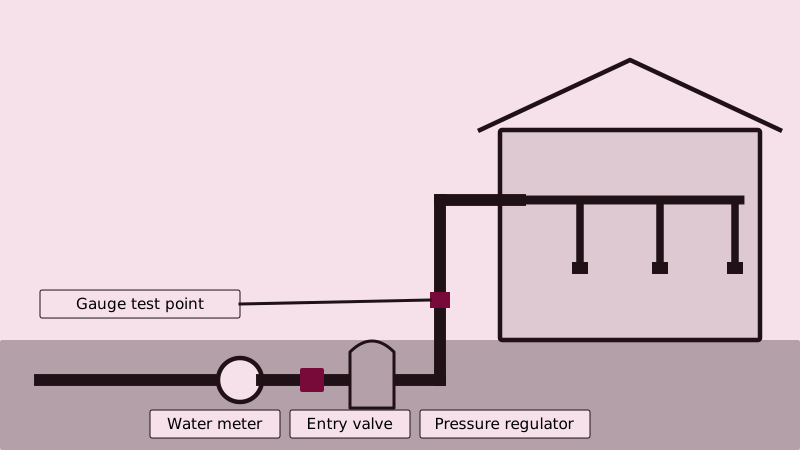
Walk the house and compare taps before you replace anything. One sad faucet is a cheap fix. A whole house of trickles points to a valve, a regulator, rusted pipe, a leaking line or trouble out on the street. We cover the repair side on our low water pressure service page, and this guide helps you sort out the cause.
How do I tell a one-tap problem from a whole-house problem?
Open the kitchen tap, a bathroom tap and the garden spigot, one after another. A single weak outlet means the trouble is local to it. Weak hot but healthy cold lands on the water heater side. All three weak means the cause sits upstream of the house branches, near the entry point or beyond it.
Keep notes, because a plumber asks for them. Did it vanish overnight or fade across a year? Does it dip in the evening when the neighbors run sprinklers? Overnight loss tends to mean a valve got bumped or a line failed. A fade over seasons tends to mean scale or rust. A spigot that gushes while the bathroom sputters tells you the street side is healthy and the indoor piping is the issue.
Which causes show up most when every tap is weak?
Five suspects cover most cases: an entry valve left partly shut, a tired regulator, crust or rust narrowing the pipe, a leak before the fixtures, and weak delivery from the water system itself. Each leaves its own fingerprints, which we walk through below.
Begin with the valve you can see. Open means the lever lies parallel to the pipe, or the round wheel has been spun all the way counterclockwise. Valves get nudged during other jobs, and replacing a heater is one classic moment when that happens. If pressure fell the same day someone worked on the plumbing, tell the plumber.
Can a worn regulator leave me with weak flow?
It can. Many houses have a bell-shaped brass regulator near the entry line, which trims the pressure arriving from the street. Once the spring or diaphragm tires, delivery can sag or swing high. The California Plumbing Code puts the ceiling at 80 psi. Thread a hardware-store gauge onto a hose connection and you will see where your house sits.
A low reading while the street is normal makes the regulator a prime suspect. Adjusting or swapping it takes a plumber little time. Locating the unit is explained in where the regulator is located, setting it in adjusting the regulator valve, and replacing it in regulator replacement.
Do old galvanized supply pipes strangle the flow?
They do, and Whittier area houses make it a live possibility. The Census Bureau's survey lists a median build year of 1959 in Downey, 1957 in Norwalk and Pico Rivera, and 1960 in La Mirada. Steel pipe galvanized in that era corrodes from the inside, and rust nodules shrink the opening year after year.

Telltale signs: flow that has faded gradually, tea-colored water after the house sat empty, and the feeblest trickle at whichever fixture is farthest from where the pipe enters. Descaling will not rebuild the wall of a rusted pipe, so the lasting answer is replacement. For what that work involves, see galvanized pipe replacement. A whole-house version is covered in repiping a house.
Can hard water scale choke pressure?
Over the years, yes. Dissolved calcium and magnesium plate out as crust in pipe, on aerator screens, in showerheads and at the bottom of the water heater. The City of Whittier's 2025 report shows hardness averaging 250 mg/L (roughly 14.6 gpg), and the Golden State Water Norwalk system reports an average of 310 mg/L.
Small openings clog first, which is why showerheads and faucet screens fail long before the main lines do. A vinegar soak revives a single aerator for a few dollars. Scale spread through the whole system is harder. Ways to slow it, including a softener, are laid out in hard water scale prevention.
Is a leak or the water company behind it?
A crack somewhere past the meter bleeds flow away before it reaches the tap. Shut every fixture, then study the meter. If the small triangle or dial still spins, water is escaping somewhere. Soggy lawn, a hiss in the wall, or a surprise bill support the suspicion, and high bills without a visible leak lists more clues.
Supplier-side events matter too. A main replacement, hydrant flushing or pump trouble can depress pressure for a few blocks. Golden State Water has been replacing mains in Hawaiian Gardens, with work scheduled to finish by the end of November 2026. When the neighbors report the same thing, contact the utility named on your bill ahead of a plumber.
Is low water pressure dangerous?
Rarely by itself. The danger lies in what causes it: a leak rotting a wall cavity, a corroding line that could split, or a valve someone left half-shut. Weak flow also keeps a dishwasher from filling and can make tankless heaters shut off when flow dips below their minimum.
Treat rusty water, wet drywall or a sinking meter reading together with weak flow as a reason to call. High pressure is the worse condition for fittings and hoses, so do not fix a low reading by cranking a regulator past the code limit. Tell us what you are seeing on the price request form, and we can set up a visit.
Common questions
Why is the shower the only weak spot?
Showerheads collect scale quickly. Unscrew yours and look for white crust or grit, since showerheads pick up mineral scale faster than almost anything else. If it is clean, suspect a clogged cartridge or a stop that is only partly open. We go into this in shower pressure troubleshooting.
Why does just the kitchen faucet dribble?
Check the aerator on the spout first. Debris and scale pack the little screen. Rinse it, then leave it in vinegar for a while. If flow stays thin, suspect the supply stops beneath the sink or the faucet cartridge, as described in sink pressure problems.
Will a booster pump solve it?
Not until you know the reason. A pump cannot open a shut valve or widen a rusted pipe, and extra pressure on tired plumbing invites leaks. If the street supply is simply weak, a booster can help, though a plumber should inspect the regulator and lines before one is installed.
Who handles this around Whittier?
A local plumber comes to test the pressure and inspect the entry valve, regulator, fixtures and lines, then explains what was found. Larger jobs fall under the state's contractor license rules, so verify the license with the CSLB before work begins.
The rest of our guides start from plumber across Whittier.