A pressure regulator is a small bell-shaped valve on the main supply that cuts street pressure down to a level fixtures can live with. When it wears, pressure rises, and the damage shows up as burst hoses, dripping faucets and hammering pipes. This page is the replacement side of our low water pressure service. For an on-site visit, use the price request form.
How do I know my regulator needs replacing?
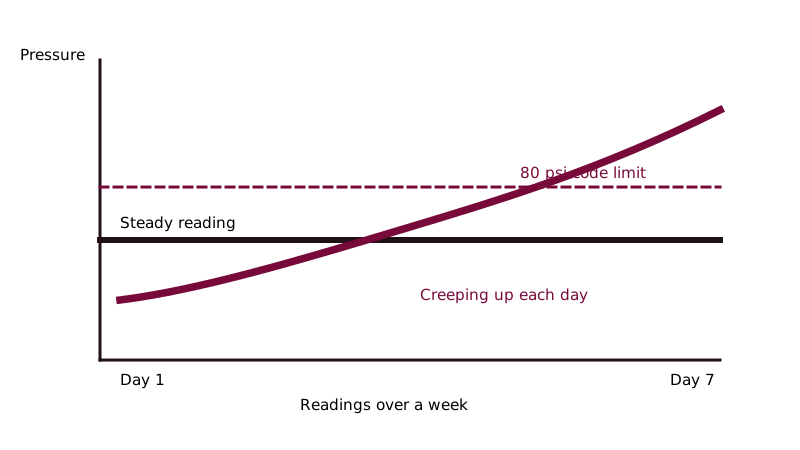
Test with a gauge. Screw a gauge that reads to at least 200 psi onto an outdoor spigot, turn the tap fully on for a minute and read it, then close it and read the static pressure. Over 80 psi is too high, and a reading that climbs over a few days is a failing regulator.
Other signs: thumping when a valve closes, toilets that keep running, a relief valve on the water heater that weeps, fixtures and appliance hoses that fail early, and steady dripping from the regulator body or its cap. Test in the morning before water use and again at peak. The California Plumbing Code limit is 80 psi. For a wider checklist, see what causes low pressure in a house, which also helps if the problem is the reverse.
How long does a regulator last before replacement?
Most are described as lasting 10 to 15 years. The spring and diaphragm wear, and minerals from hard water can shorten that. Some fail at three years, others run past twenty, so the gauge is a better guide than the calendar. Replace on symptoms, not on a fixed date.
Whittier's city water averaged about 250 mg/L total hardness, near 14.6 grains per gallon, in the 2025 report, and grit and scale tend to collect inside valves. Some plumbers advise a check every five years. If you have a regulator of unknown age, ask the plumber to test it when the water heater is serviced. Our page on where the regulator is located helps you find it.
What does the replacement involve?
The plumber closes the main, relieves the pressure, cuts out or unscrews the old valve, fits the new one in the same size, usually three-quarter or one inch, and sets it to the target pressure with a gauge. Unions make later swaps easier. The system is then tested for leaks, and the heater's pressure relief valve is checked.
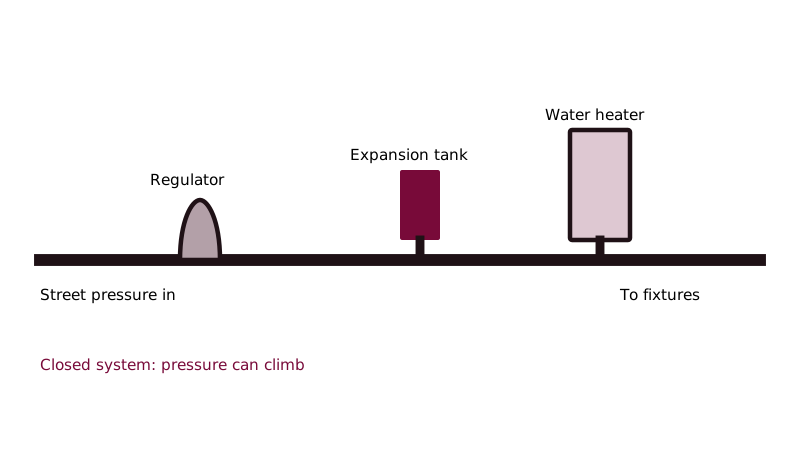
Parts matter. A regulator is matched to the pipe size and flow, and dissimilar metals can corrode where they meet, so fittings are chosen to suit. A regulator can also create a closed system, where heated water has nowhere to expand, and an expansion tank may be needed. See expansion tank replacement. A plain adjustment of a working regulator is covered in how to adjust the valve.
What does it cost to replace a regulator?
Published guides list the valve at $50 through $150 and professional labor at $200 through $500, so an installed price commonly lands in the $250 through $650 range, and more for a buried or corroded main. These are national guide figures. The plumber's written quote is the number that counts.
What raises the price: a regulator buried in a meter box or behind a finished wall, a corroded pipe that needs replacing, an expansion tank, and a size change. What keeps it low: easy access, a straight swap and a valve of the same size. Ask whether the quote includes a before-and-after gauge reading. Installation cost goes into pricing in more detail.
Can I replace it myself?
It can be done by a handy homeowner, but the stakes are high. You are working on the main supply, and an error floods the house. California requires a contractor license for work of $1,000 or more in labor and materials, and for any job that needs a permit. A regulator swap is usually below the dollar line, but a permit may apply, so ask your building office.
For Whittier, the Building and Safety Division is at (562) 567-9320. If you try it, shut off the main, drain the line, use unions, and test with a gauge. If the main shutoff does not close fully, stop and call a plumber. Old shutoffs can seize or leak when turned. A mistake in setting the pressure can leave you with too little water, as well as too much.
Why do hillside homes see higher pressure?
Water pressure rises as elevation drops, so a home low on a slope can see higher pressure than one at the top. The effect is physics, about 0.43 psi for each foot of drop. Neighborhoods in the Puente Hills, including La Habra Heights and Hacienda Heights, have varied terrain, so pressure can differ from house to house.
La Habra Heights is served by La Habra Heights County Water District, and Hacienda Heights has more than one water provider depending on your street. Whittier has its own city system. That means no single pressure number applies, and the gauge reading at your own house is the one to use. If yours is above 80 psi, a regulator is a good fix. If it is already fitted and the reading is high, replacement is due.
Does a tankless heater or a softener change anything?
A tankless heater has its own working pressure range in its manual, and the house regulator keeps incoming pressure inside it. Softeners and other appliances list pressure limits too. Neither needs a separate regulator on its own, but both are a reason to keep house pressure in the normal band of 40 to 60 psi.
If you have a regulator that is fine but a heater valve is weeping, the issue may be thermal expansion, not the regulator. Read pressure relief valve replacement and water hammer sounds for those symptoms. If you suspect a leak after a pressure spike, see leak repair. The home page lists the other jobs we arrange.
Common questions
Can I adjust a regulator instead of replacing it?
Often, yes, if the valve is still sound. Loosen the lock nut and turn the adjusting screw while watching a gauge, since a half turn can change the reading a lot. If the pressure keeps rising after adjusting, the diaphragm is failing and replacement is the cure.
Is a regulator the same as a pressure relief valve?
No. A regulator is on the main supply and reduces incoming pressure. A relief valve sits on the water heater and opens to release dangerous temperature or pressure. A weeping relief valve can be a symptom of high pressure or a closed system, which a regulator or expansion tank may fix.
How long does a replacement take?
A straight swap with good access often takes one to two hours. A buried regulator, a corroded pipe or an added expansion tank takes longer. Water is off during the work, so plan for it. Ask the plumber for an estimate when you book.
What psi should the new regulator be set to?
Most homes aim for 40 to 60 psi. Readings of 60 to 80 are usable but harder on fixtures, and over 80 breaks the California Plumbing Code. The plumber sets it with a gauge and may choose a point in the middle of the range that suits your fixtures.