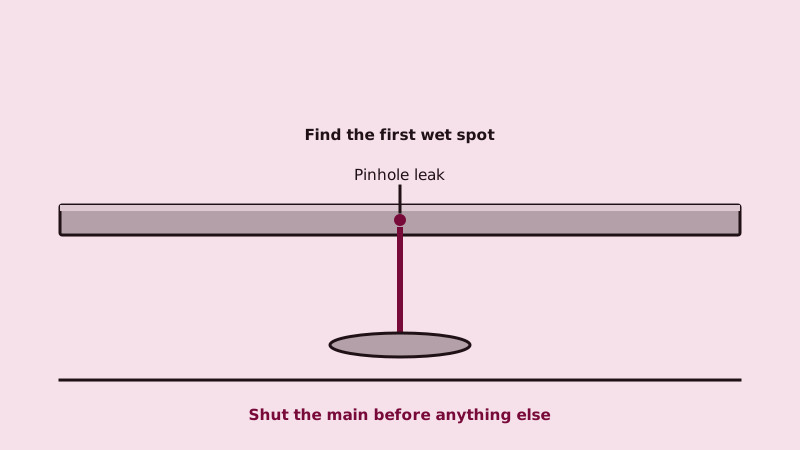
Repairing a leaking supply pipe begins with shutting off the supply and drying the spot. From there, pipe type and damage point to one of two paths: a clamp or epoxy putty as a stopgap on a pinhole, or a plumber who removes the bad run and splices in new pipe for a lasting fix. How help gets booked is explained under plumber for leaks.
What do you do the moment you see water?
Shut the main water valve first. Next, drain the pipes at the lowest tap, and haul anything valuable away from the spray. If water has reached outlets, the breaker panel is off limits if reaching it means wading through water. Otherwise stay back and phone an electrician.
Water plus electricity is dangerous. Stay away from wet outlets, appliances and cords, and never wade toward a panel through standing water. Photograph the damage for insurance before cleaning up, and use towels and a wet vac to limit the spread.
Find the main shutoff before the emergency. In many Whittier-area houses you will find it by the curb meter, or near the foundation where the supply pipe enters. A main that will not turn needs replacing, and the plumber can do that first.
How do you track down where it starts?
Follow the wetness back uphill. Dry the pipe off and watch for the first bead, or hold dry tissue to the pipe and note where it darkens. Leaks within walls and floors announce themselves as stains, warped baseboards, a musty smell, or a water meter that advances with every tap off.
The meter test is easy: write down the dial, keep every tap off for two hours, then look for movement. Any change means water is getting out. Leaks waste water quietly, and the EPA's estimate for a typical home runs past 9,300 gallons annually, so even small ones deserve tracking.
Hidden leaks call for acoustic listening gear, thermal cameras and pressure tests. Leak detection pricing describes the process. If the signs arrived suddenly, read signs of a burst pipe.
Which temporary patches are worth trying?
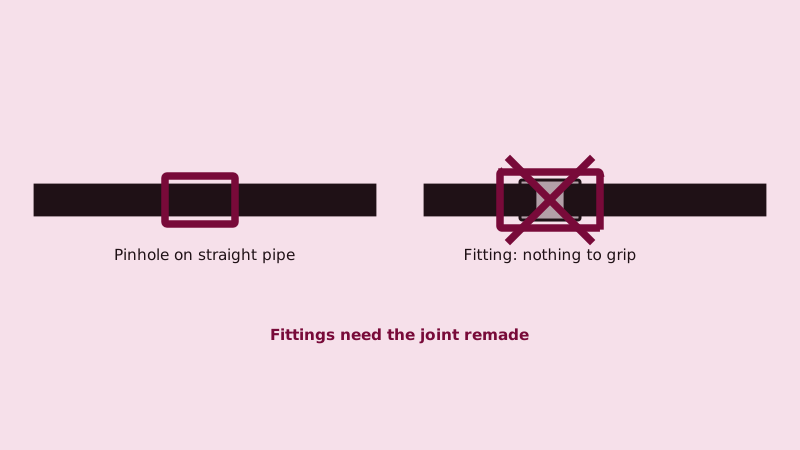
On a pinhole or hairline split, you can try a rubber-lined clamp, silicone wrap tape or two-component epoxy putty, any of which may quiet the drip for days or months. They work best on clean, dry, healthy pipe. None of them cures corrosion, and the metal around the patch keeps thinning.
By situation:
- Pinhole in copper: clamp or putty now, replacement section soon. Copper specifics are in copper pinhole leaks.
- Weeping joint or fitting: sometimes a tightened nut, otherwise the joint is cut out. Read leaking pipe joint repair.
- Drip under a sink: start with the supply lines and trap, covered in leaks under the sink.
- Galvanized steel: patches rarely last because the pipe is corroded along a length, not at one point.
Think of every temporary fix as time bought until a plumber can cut and replace.
What does the permanent fix look like?
The plumber isolates and drains the line, removes the damaged length and splices in new pipe, using soldered or press fittings on copper, crimp or expansion fittings on PEX, or push-fit couplings. The finished section is pressure-tested before any wall is closed. Pipe type, access and number of leaks set the price.
Press and push-fit couplings let a plumber fix a section without a torch, which helps in tight spots. When pipe leaks in several places, patching one at a time costs more than replacing the run, and that is the point where whole-house repiping enters the conversation.
A solid quote spells out the pipe material, the length replaced, wall or ceiling restoration and any permit. Ask who files the permit if the work needs one.
What will a leaking pipe repair set you back?
In a 2026 cost survey, slab leak repair ran $1,500 to $6,000, a whole-house repipe ran $4,000 and climbed past $15,000, and fixture-level repairs came in well below those. Reachable pipe repairs follow the plumber's hourly rate of about $75 to $175 plus a call-out charge, with drywall repair extra.
Those are market figures, not quotes. Access dominates: a leak behind an open cabinet costs a fraction of one under concrete or behind finished drywall. Slab leak repair cost goes deeper. The same survey puts permits at $50 to $500 depending on scope.
If drywall, flooring or insulation has been damaged, ask whether the quote covers demolition and patching or only the pipe.
Why do pipes leak so often in older southeast LA County homes?
Age and water chemistry. Postwar houses across Whittier, Downey, Norwalk and Pico Rivera frequently have galvanized steel pipe or early-era copper tubing, and both rot from within. Whittier's 2025 report lists total hardness averaging 250 mg/L, which leaves scale in pipes and fixtures.
Census figures put the median Downey home at about 1959, and the median Norwalk and Pico Rivera homes at about 1957. Pipe of that vintage is often at or past its working life. The pattern of past leaks tells a plumber whether to repair or replace. For steel lines, see galvanized pipe replacement.
Houses plumbed with polybutylene, a gray plastic pipe found in certain homes built after the late 1970s, follow the same logic. See polybutylene pipe replacement.
Want a price on a repair? Request a quote. The Rio Hondo Plumbing main page lists where we work.
Common questions
Can a pipe leak be patched rather than replaced?
For a while, yes. A clamp, rubber patch or epoxy putty may seal a pinhole or small split, as long as the surface is clean and dry. Consider it a bridge and not a remedy, because the weakened section will still need a plumber.
Is fixing a leaking pipe a homeowner job?
For a small leak within reach, yes. Close the main and empty the pipe. After that, add a repair clamp or push-fit coupling, or splice in a short piece of new pipe. A plumber should take over when the pipe is steel or inside a wall, if several leaks show up, or if a permit is involved.
How long can a leaking pipe wait?
Not long. Even a slow drip can soak drywall and insulation within days and invite mold. If a fix is not coming soon, close the main. Unseen leaks keep wasting water, and the EPA's average household loss tops 9,300 gallons yearly.
Does a pipe repair need a permit?
A small like-for-like repair often skips it, while longer replacements and repiping usually need one, and the contractor doing permitted work must hold a California license. Raise it with the plumber before work starts, or ask your city's Building & Safety office what it requires.